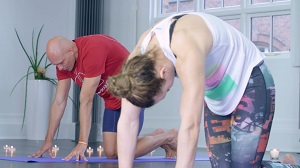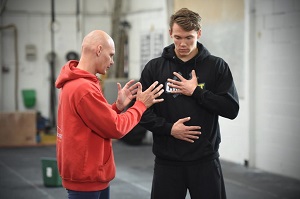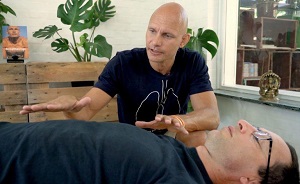
The "Complete Breath" in Yoga There are probably several variations on this but this one is the one I see most of the time. I recommend against this and include it so you know what I am referring against. The standard yogic precept is that inhalation is made up of several phases: 1. Diaphragmatic or abdominal breathing induced by lowering and flattening the dome-shaped diaphragm causing the belly to protrude.. 2. Intercostal breathing brought about by expanding the rib cage as the belly comes inward to force the breath upward. 3. Clavicular (collar bone) breathing from the top of the lungs, produced by raising the upper part of the thorax as the belly gets pushed inward and upward driving the diaphragm higher up into the chest. Supposedly each of these phases has its own merits, but in theory yogic inspiration is only complete when all four are done in proper sequencing This by the way has little to do with optimal natural breathing. First of all they say one needs to practice breathing from the diaphragm. 1. First empty the lungs by extending the exhale by forcing breath out by strongly squeezing inward the belly muscles towards the spine and upward into the chest cavity. 2. Slowly breathe in allowing the belly to relax and enlarge and the diaphragm to lower and allowing air to enter the lungs. When the abdomen swells the hope is that the bottom lobes of the lungs are being filled with air, which if abdominal tensions allow, often occurs. 3. Second stage of inhale would be to expand the ribs without straining. 4. Third stage of inhale is to allow the lungs to completely fill by raising the collar-bones (another good way to create UDB.) Throughout this procedure, the air should enter and exit from the mouth or nose in a continuous flow with no gasping. No noise must be made for it is essential to breathe silently! It is of the utmost importance to concentrate the mind entirely upon the action of breathing! When the lungs are completely filled, breathe out, in the same sequence as
when inhaling ie; top of ribs, down to mid chest down to belly. Try it several times daily. Breathe easily without straining. Remember that the ideal respiration is deep, slow, silent, easy. The hope is that gradually you will acquire the habit of complete respiration, and your method of breathing will improve as you go on. Unfortunately this is not the case with many people. It DOES give many a sense of improvement and MAY even enhance breathing mechanics somewhat. But my experience with this is that it heads many in the wrong direction for optimal breathing and develops blocks in future potential for natural breathing development and balance of the breathing driven Autonomic Nervous System.
Let’s get the physiology right.
From a newsletter reader: "I do breathing exercises (pranayama) but I want to know what I can do to make my breathing better. How can I make each breath longer, without having to think about my breathing? thanks!" From Mike: Get this program. www.breathing.com/video-ds.htm
|
|
|
Home |
Overview |
Free Breathing Test |
Free Newsletter |
Store |
Office Visits |
Practitioner Trainings |
Voice Clinic |
Sleep Clinic |
|
Seminars |
Articles |
Health Q & A |
Health Tips |
Testimonials |
Miscellaneous |
Affiliate Program |
Contact Us |
About Us |
Michael Grant White, Breathing.com,
1800 Camden Rd. Suite #107-36, Charlotte, NC, 28203 USA
Toll-Free Phone: 866 MY INHALE (866 694 6425)
International Phone: 1 704 332 7663
© Copyright 1997-2008 Breathing.com. All rights reserved.
|
Terms & Conditions |
Privacy Policy |
Translate |
Currency Converting |
Report Deadlink
The breathing improvement
techniques, practices and products outlined in this publication are extremely
gentle, and should, if carried out as described, be beneficial
to your overall physical and psychological health. If you have any serious medical or
psychological problem, however, such as heart disease,
high blood pressure,
cancer, mental illness, or recent abdominal or chest surgery, you should consult your
health professional before undertaking these practices.