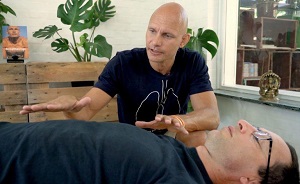
Optimal Position and Exercise for Primary Reflex Development In practicing optimal breathing it is most often best to be in a supine position using the PRP in the Secrets Manual. See below. In this position the diaphragm is not working against gravity and you are not bringing any voluntary muscle into play just to balance and support the body. The hardest thing you have to do is to think that you are not going to work. You are not going to work on the inhale or the exhale.
Note the SMALL pillow strategically placed under the mid back to open up the chest. Also experiment with the pillows and various props listed in the Secrets manual. The chair can be substituted for a very large pillow such as a couch pillow. The goal is to extend the exhale to its natural conclusion. You make sure the jaw is loose and you open the mouth on the inhale. This doesn't mean you have to do all mouth breathing; but at this point, it helps to keep the throat open. After the inhale comes, you start with the only thing that can be called an exercise, making audible sound. This is the developing process. It is like a weight lifter lifting weights. So, you should start to count very simply. Sometimes it is better to start with two at a time. That means that you count quietly until the inhale comes as a reflex. When the inhale comes, you count “1–2” out loud; then you count quietly (almost a whisper) again to relax the exhale as far as it will go until the next breath comes. Then you count “1–2–3–4” and continue in this manner. If that is very, very easy for you, you may increase the count by 5's instead of by 2's. The other important thing to remember is that ultimately you want to be heard. That doesn't mean that you are making an effort to be loud; but at the same time, you have to think of projecting the sound, otherwise the throat won't stay open when you're making sound. If this goes easily, every so often prop your knees up and let your knees swing from side-to-side to loosen the lower back. You may also put your hands together in front of you and let them swing from side-to-side to loosen your shoulders. All of this should be done while you are lying down. Also, be sure that while you are making the swing and moving the body, you are doing that on an exhale; and counting quietly helps to keep that exhale going. The point is to be able to extend the exhale as long as possible with sound, but not by making an effort. You never want to force when either inhaling or exhaling. Just the fact of priming the diaphragm to make the sound is enough. You may be able to get to a length of count of 40 or 50, without rushing, but keeping it moving, by doing it in a sort of sing-song manner. If you do a count that is too precise, the diaphragm may not be moving smoothly. Whereas, if you make a sort of sing-song sound, you are making one single effort. When this is very easy and the count begins to progress, it should be relaxing. The reason it should be relaxing is due to the fact that you are increasing the amount of oxygen in circulation. Oxygen relaxes muscles and nerves; carbon dioxide tenses them. While you are counting, you can make sure that the diaphragm is rising. If the diaphragm is tensing, you can feel the pressure in your lower abdomen, between your hip bones. The lower abdomen is not contracting, but it drops inward when the diaphragm rises. When the diaphragm rises, everything above it and below it releases, so that you can feel the chest and the lower abdomen both dropping toward your spine. If the count goes too far and the diaphragm begins to tense, you feel the pressure in the lower abdomen. Don't push past that. When this becomes easy, you may see whether you can accomplish the same thing sitting or standing. The sensation should be similar. In addition to the quiet counting, you may also do “la–la–la” sounds, in which the tongue moves from behind the top teeth to behind the bottom teeth. It does not involve the jaw. This can be done without any sound and with the mouth hardly open, so that you can use it any time, any place, just for relaxation and to prime the exhale. The best time to practice is the first thing in the morning and the last thing at night. You should prime your breathing before you start making physical demands. If you do it the last thing before bed, it should be very relaxing, you get better sleep, and your breathing doesn't become too shallow. Of course, at any time in your schedule that is convenient, you may practice for about 10 minutes. The more you do it, the faster you can develop, as long as it is done in a relaxed manner. The length of the practice should depend on your success. If it is going very well and you have the time, you should continue much longer. If it is not going well, let it go and come back to it at a later time. This is about as clear as it can be in writing but if you have trouble with it I am available for consulting by phone.
|
|
|
Home |
Overview |
Free Breathing Test |
Free Newsletter |
Store |
Office Visits |
Practitioner Trainings |
Voice Clinic |
Sleep Clinic |
|
Seminars |
Articles |
Health Q & A |
Health Tips |
Testimonials |
Miscellaneous |
Affiliate Program |
Contact Us |
About Us |
Michael Grant White, Breathing.com,
1800 Camden Rd. Suite #107-36, Charlotte, NC, 28203 USA
Toll-Free Phone: 866 MY INHALE (866 694 6425)
International Phone: 1 704 332 7663
© Copyright 1997-2008 Breathing.com. All rights reserved.
|
Terms & Conditions |
Privacy Policy |
Translate |
Currency Converting |
Report Deadlink
The breathing improvement
techniques, practices and products outlined in this publication are extremely
gentle, and should, if carried out as described, be beneficial
to your overall physical and psychological health. If you have any serious medical or
psychological problem, however, such as heart disease,
high blood pressure,
cancer, mental illness, or recent abdominal or chest surgery, you should consult your
health professional before undertaking these practices.