|
|
Unbalanced
Dysfunctional Breathing
- UDB©
Does your breathing feel small, unsatisfying, or inadequate or weak, stuck,
sometimes as if it's barely there,
suppressed or held back, it seems to go in the
wrong place when trying to breathe deeply. Your breathing just doesn't "feel
right", but you're not sure what's wrong or why.
The Way You Breathe Can Make You Sick!
Read about the
conditions below that seem to fit your situation. Print a copy or
download the pdf here
|
Our
breathing tests show that as
breathing volume, depth, balance and ease decrease,
there is a much higher correlation of diagnosed illnesses.
Silent disease(s) may be slowly developing.
|
|
 |
This UDB check sheet is an
alert to increase your awareness related to health conditions in life that
are directly and indirectly impacted by the quality of how well you breathe.
This check sheet below calls to our
attention many factors of life that we may not have considered as being
connected with breathing.
The "hidden" conditions that serve to encourage further investigation about whether your
breathing might be lessening and your health might be negatively impacted
without your knowledge.
The U in UDB stands for Undisclosed
Undetected or Unbalanced
The D stands for Deep
and/or Dysfunctional B stands for
Breathing
Unbalanced Deep Breathing.
Undisclosed Dysfunctional Breathing. Undiagnosed Dysfunctional breathing.
breathing pattern disorder
UDB
ruins breathing exercises, meditations and attempts at stress management.
UDB causes
or worsens high blood pressure, shortness of breath, hyperventilation, overbreathing,
anxiety, panic attacks, seizures, nervous disorders, depression, pain, asthma, COPD and
most illness.
Also, it is probably present in most if not all aspects of
psychosomatic (mindbody
or bodymind) disorders.
Because breathing is a moment to moment 24/7
activity the key is to make sure the way you breathe is not influenced by or
is caused by, causing or worsening any of the following.
|
|
Close
your eyes, go within and take the deepest in and out breath you can take,
now take another in and out breath. Then allow yourself to breathe
normally, and open your eyes and reflect on whether then or if you often
experience any of the following conditions correlated with possible
obvious or hidden breathing dysfunction. If this list seems
too long please consider oxygen's and breathing mechanic's
relationship to life. |
|
Problems existing now…
1. An addiction
2. Air temperature while sleeping exceeds 72 degrees.
3. Allergies
4. Altitude make breathing harder
5. Anxiety
6. Anger
7. Apathy
8. Apnea
9. Attention problems
10. Back pain: low mid upper
(circle)
11. Belch a lot.
12. Bowel or rectum disorder
13. Blood sugar swings
14. Breathing Problems: asthma,
bronchitis, emphysema,
COPD, other
15. Breathing feels like a series of
events, instead of one smooth
coordinated continuous flow
16. Breathing feels stuck
17. Breath heaving
18. Breathing labored/restricted
19. Breathing is shallow
20. Breathlessness
21. Can’t catch breath or deep
breathing curtailed
22. Can’t feel breath in nostrils
23. Can’t meditate
24. Can’t relax
25. Can’t sleep on back
26. Can’t walk and easily talk at
the same time
27. Chest is large and stiff
28. Chest pain
29. Chest sunken
30. Chest tightness after surgery
31. Chest wall pain
32. Chronic cough
33. Chronic pain
34. Cold hands or sweaty palms
35. Cold temp bothers breathing
36. Confrontations make your
voice pitch go up
37. Confused or sense of losing
normal contact with
surroundings
38. Constant fatigue
39. Constipation, cramps in
abdomen or below sternum, or
side stitches
40. Depression
41. Digestion poor
42. Diaphragmatic impairment
43. Dizzy when excited/anxious
44. Do you often PRESS your
tongue to the roof of your
mouth?
45. Dry mouth
46. Exercise induced asthma
47. Fanny sticks out in rear
48. Fall asleep watching TV or at
theater when you would rather
watch the program
49. Fear is excessive
50. Feel a hitch, bump, or lump
right below your breastbone
when you try to take a deep
breath
51. Feelings of suffocation
52. Finish other’s sentences for
them
53. Furrows brow often
54. Gasping |
55. Get tired from reading out loud
56. Get drowsy from driving a
vehicle
57. Grind or clench teeth
58. Headaches
59. Heart condition or attack
60. Heavy breathing
61. High blood pressure
62. History of being choked
63. History of other abuse or trauma
64. Hold breath a lot
65. Hormonal fluctuations
66. Hot flashes
67. Hyperventilation, overbreathing
68. Hypoglycemia
69. Irregular heartbeats
70. Irregularly formed rib cage
(Can you see it in a mirror?)
71. Jaw tension
72. Jet lag
73. Look in a mirror and breathe as
deeply as you can. Do your
neck muscles bulge out? Do
your shoulders or collar bones
rise?
74. Lump in throat
75. Migraines
76. Mitral Valve Prolapse
77. Mouth breather
78. Nervous quiver in voice
79. Nightmares
80. Nodules
81. Obese
82. Often catch yourself not
breathing
83. Often shift weight from side to
side while standing
84. Panic attacks
85. People have difficulty hearing
you and you are not partly deaf
86. Phobic
87. Poor boundaries
88. Poor posture
89. Pregnant
90. Perfectionist
91. Public speaking
92. Pulsing or stabbing feeling
around ribs
93. Reduced pain tolerance
94. Reflux
95. Repetitive strain injury
96. Ribs flair outward at bottom
during inhale
97. Sallow complexion
98. Scoliosis or abdominal
curvature of the spine
99. Seizures
100. Self esteem poor
101. Shortness of breath
102. Shortened stride
103. Shoulders rounded downward
104. Sigh or yawn often
105. Singing poorly
106. Sleep problems
107. Smoking
108. Snore
109. Soreness or pain in throat with “prolonged” vocal use
110. Sore deep pain that feels like a band across your chest
111. Speech problems
112. Stiff neck
113. Stressed out
114. Stomach tense and unable to relax it |
115. Stroke
116. Sunken chest
117. Superman Syndrome
118. Sustaining low tone
difficulty
119. Swallowing difficulty
120. Swim-can’t as well
as you use to or tried and get short of breath.
121. Talking on the phone makes
you short of breath
122. Tension around the eyes
123. Tense overall feeling
(hypertension)
124. Thoughts run amuck
125. Ticklish in your ribs or armpits
126. Tightness around mouth
127. Thoracic insufficiency
syndrome
128. Tightness, soreness or
pressure in chest or below
breast bone
129. Type “A” personality
130. Upper note singing problems
131. Upset stomach or irritable
bowel syndrome
132. Vertigo
133. Vision blurred,
cataracts, eyesight,
better in AM than PM
134. Voice is:
VCD
-vocal chord dysfunction, clear,
labored, held back, strained, natural, thin, strong, weak,
dynamic, heavy, smooth, clears throat often, chest,
whispery, stutters, quiver,
squeaky, restricted, choppy, laryngitis, hoarse, crackly,
disconnected, raspy, broken, breathy, erratic, monotone,
tentative,
nasal, throaty, mumbles,
nervous, slurred speech,
spasmodic dysphonia
135. Voice feels weak
136. Wake from sleep suddenly not breathing
137. Use a mechanical breathing device while sleeping
138. Washboard abs
139. Wake up tired a lot
140. Wheezing
141. Worsened breathing following laughter
Breathing is mainly
(SH)=Shallow; (L)=Labored;
(F)=Fast; (SL)=Slow;
(D)=Deep; (B)=Belly;
(HC)=High chest;
(CO)=Cough; (HB)=Hold breath; (E)=Erratic; (EA)=Easy;
(SM)=Smooth; (FO)=Forced;
(O)=Other
|
Do you or someone you
care about have UDB?
UDB can make you
anxious, make you sick
or sicker, make
you think you are sick or crazy, destroy your energy, keep you
fat, steal
your personal power, hinder your voice and shorten your life. Your
may know there is something wrong with your breathing. You may feel ok but
your breathing may still still
be severely unbalanced.
First, bend over and notice how much harder it is to breathe.
Please just do that right now so you get the feel of what I am saying.
This breathing difficulty is because
your muscles are restricting the ease and depth of your diaphragm and rib
expansion as they relate to 360 degree functionality. There are many
expressions of this, without even being aware
of them. More about that in a few paragraphs. Properly supported
breathing is similar to the foundation or basement of a building
supporting the upper structure but having little else to do with its
internal functioning.
Many breathing related health issues are sub-clinical.
They are not detected by traditional diagnostic methods. The diaphragm and rib cage do the inhaling and exhaling. Any other
muscle being engaged is purely supportive. Proper support/guidance from
accessory breathing muscles is similar to how an elevator shaft guides the
elevator but does not carry the passengers though it may enclose them.
Bend the shaft (poor posture) and the elevator will not rise or if you are
used to thinking of this as an umbrella opening, it will not open as
easily or at all; or book stacking, the books will reach a certain height
and prematurely cease rising, inhibiting ease and depth of the next
inhale. As a result, the oxygen cost of breathing greatly increases and
the Autonomic Nervous System functioning becomes over-stressed and
distorted. Keys to my own breathing development lay hidden for 45 years. It
took so long because I had, what I learned to describe as
Unbalanced Deep Breathing Mechanics or what I now call UDB©.
I’ve observed that, MANY others live 24/7 with UDB,
just as I did. Some KNOW there is something wrong with their
breathing but don’t know what it is and what to do about it.
Others go from health professional to health professional, spend
thousands of hours and small fortunes in medical expenses that
often include harmful medications. Their breathing development
problem remains undetected
Attempts at
taking a forced deeper breath, or struggling against shallow or
restricted breathing can trigger or worsen UDB. UDB can act
like a warning sign much like hypoglycemia can be a predictor of
potential diabetes. This “Hidden” or tendency towards UDB lies
waiting to present itself.
UDB and its relationship to living.
Deeper easier breaths bring deeper
people friendly feelings. We feel more strongly and live more passionately. With more
passion comes bigger mistakes, bigger dreams and bigger dreams coming
true. When the deeper breaths are out of
balance the deeper feelings invite distorted responses. Life and living
comes out bent, misshapen, crooked.
BEWARE You cannot tell bad, good or great breathing by merely observing it. The
breathing development student MUST be trained to sense and feel it from the
inside out so that he or she can guide self and others properly. Function
and or skill levels
may also be extremely relevant.
UDB
STRIKES or is WORSENED by stress, trauma, fatigue, fear,
anxiety, panic or even positive emotions. Because it can hide
itself so well, Many with UDB seem “normal”. These "normal"
people worry me.
One of our long term goals is to
enable health professionals, coaches and trainers to quickly spot what
might be a breathing issue so it can be addressed instead of overlooked
and cause a direct or indirect worsening of a health or performance issue.
This check sheet is step one.
Step two is attending
our school or getting one of our
home study courses.
Breathing Assessment Tip.
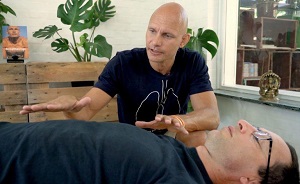
Begin by observing someone breathing,
having asked them to take deep in- breaths and relaxed out breaths on their belly, on
a fairly hard surface such as a hard mattress, massage table or a carpeted floor. The breath should begin in the low back and
slowly rise /move
upward to the mid back but without the lower back reducing in size. If it begins in the mid or upper back
or the low back gets smaller this is a
sure sign of UDB.
Below is an example of an extreme
case
so you can see if perhaps you or someone you care about might
be a candidate for breathing development. Lesser degrees
of intensity become apparent as one becomes more familiar with
the above UDB possibilities. |
From a recent web site visitor.
Dear Mike, I could not breathe, I was having terrible pain
in chest, in my back, in my neck and I couldn't breathe. I
thought I was dying!! So I decided once again to get on the
internet and this time I searched on this subject..."......" before I was doing a search on
chest pains and nothing...just lots of fear that I was dying
from a heart failure (since my dad's side has lots of heart
failures and strokes) which maybe could have been from anxiety
something I have really bad. But back to the pain and gasping
for air, I did the optimal breathing steps for chest
pain...and OH MY GOD. I feel so much better!!! Still a little
dull pain but nothing like the stabbing, sharp, unbearable pain
I was having. Now maybe I can go sleep for awhile instead of
listening and watching my husband sleep soundly and
comfortably while I lay there and panic with very intense pain
wondering what I am dying of and when it will be. I have
suffered a long time from this chest pain...too long!! And I
have suffered long enough with anxiety and panic attacks, I
have had without knowing it since I was a little girl. My mom
was very abusive emotionally and physically. I read a lady's
testimony and just cried.. We both suffered from the same
abuse growing up...when I would get a beating I would hold my
breath, or get yelled and so on...it hit me yes that's why I
can't breathe...I would hold my breath, and emotions came out
of me that I did not know were there. It feels so good to get
some air into my lungs!! As soon as sleeping beauty wakes up I
will take the free breathing tests and order the right tape
for me. I cannot wait to get some air in me and get rid of the
chest pains!!! Thank you so much for giving me this chance to
breathe again!!! Sincerely, Stephany as I am very tired, so
please excuse me if I wandered off a little with my story".
From Mike to everyone:
Please
go into all this more deeply to help guide
you toward effective methods of developing your breathing and/or reducing or eliminating UDB. Our
Deepest Calm,
Breathing Development
Fundamentals
or most popular program
are the ones that satisfy most people. You may well be able to improve your
breathing on your own with one of our self help programs. However, we
always suggest you see a health professional when any sort of disordered
energy presents itself. Bring this UDB list with you.
From Mike: There are varying kinds and degrees of UDB. Take
our free breathing tests and learn what we recommend. |
|
"Breathing
is the FIRST place not the LAST place one should
investigate when any disordered energy presents itself."
Sheldon Saul Hendler, MD Ph.D., The Oxygen Breakthrough
|
"He who breathes most
air lives most life."
Elizabeth Barrett Browning
|
|
.
|